How Brands Protect Their Handles
By David James · Published · 5 min read · Editorial policy
Free, no sign-up. Checks 3,450+ sites; the username is not stored or logged.
For a brand, a social handle works a lot like a domain name. Customers type it, journalists tag it, and scammers copy it. Losing it to a squatter, or watching an impersonator build a following on a near-identical name, costs real money and trust. Brands that avoid this usually aren't lucky. They treat handles as assets with an owner, a process, and a review date.
This post looks at how brand teams handle that day to day. If you are a small business setting up for the first time, our step-by-step brand protection guide covers the basics. Here we go into what happens before a launch, what platforms will and won't do, and how teams keep control of accounts once they have them.
Check before the name goes public
The riskiest moment for a handle is the gap between a name leaking and the brand claiming it. Product names show up in trademark filings, domain registrations, job listings and conference agendas before launch day. Anyone watching can register the obvious handles first.
Brand teams close that gap by checking and claiming early:
- Search the candidate name everywhere before it is final, not just on the five biggest networks. A name that is free on Instagram but taken on a popular gaming platform or code host may still cause confusion.
- Check several variants at once: the bare name, the name plus "hq", "app" or "official", and the spellings people will guess.
- Claim the handles before the announcement, even if the accounts stay empty for a while. An empty account you control is better than a full one you don't.
Our username search takes up to five names at once and checks 3,450+ sites, so you can compare variants side by side. It also checks .com, .net, .org, .io, .us, .app and .dev domains through public RDAP data. If you want one platform only, the platform checkers are quicker. Read Found results with care. A Found result only means a profile with that name exists. The tool shows the public display name, avatar and bio when the site exposes them, which helps you judge whether the account is active or abandoned.
What platforms will and won't do about squatters
Many brands assume that a trademark gets them any handle they want. It doesn't work that way. Platforms set their own rules, and they differ.
X is a useful example because its policies are public. Its username squatting policy prohibits squatting, but says X will not release squatted usernames except in cases of trademark infringement. Buying or selling usernames is also a violation. Its inactive account policy says it cannot release inactive usernames unless you have a trademark claim, and suggests picking a variation instead.
A few lessons carry over to most platforms:
- A registered trademark helps. Platforms' intellectual property forms usually ask for registration details. Check the USPTO trademark search to confirm your own filings and spot conflicting ones.
- An inactive account is not the same as a squatter. Someone who registered a common word years ago and never posted is usually not breaking any rule.
- Don't pay for a handle. Many platforms ban buying and selling usernames, and a purchased account can be suspended later.
- Plan for a variant. A consistent variant like
brandhqeverywhere often works better than the bare name on half the platforms and a mix of others elsewhere.
Watch for lookalikes, not just exact matches
Exact-name squatters are the easy case. The harder problem is impersonators who register near matches and use them to run fake giveaways, fake support desks and phishing links. Common patterns:
- An extra word:
brand_support,brandhelp,brandofficial. - Swapped or doubled letters, or a lowercase L standing in for a capital I.
- Separators:
brand.co,brand_co,brand-co. - A country or product suffix the brand never uses.
Brand teams build a short list of these variants and check them on a schedule, often monthly, and weekly around launches or sales. Exporting results to CSV or JSON makes it easy to compare one check with the last and spot new accounts. Reporting goes through each platform's impersonation or trademark form, which almost always asks for links to the official account. That's another reason to have one.
Keep control of the accounts you own
Plenty of brand handles are lost from the inside: a freelancer leaves with the password, a former employee's personal phone holds the two-factor codes, or the recovery email belongs to a mailbox nobody checks. Good teams handle this like any other company system.
- Register accounts to a company-controlled email, such as a shared social mailbox, not a person's work address.
- Use the platform's business or team access features where they exist, so people get their own logins instead of sharing one password.
- Store credentials in a company password manager with access you can revoke.
- Turn on two-factor authentication and keep backup codes where more than one trusted person can reach them.
- Keep a register of every handle: platform, URL, owner, recovery email, and the date it was last reviewed.
- Add social accounts to the offboarding checklist. Rotate passwords and remove access the day someone leaves.
Make the real accounts easy to recognize
Customers fall for impersonators when they can't tell which account is real. Make it easy for them:
- Use the same handle, name and logo across platforms wherever you can.
- List your official accounts on your website, and link to the website from each profile.
- Apply for platform verification where it is available and makes sense for your size.
- Tell customers in your bio or FAQ how you will and won't contact them. For example: "We never ask for passwords or payment by direct message."
Audit what already exists
Older brands often find forgotten accounts: a test account from a 2015 campaign, a regional page someone set up, a gaming profile from a sponsorship. Those accounts can be hijacked and used against you, and they still carry your name. A periodic audit across many sites, not just the big ones, catches them. Delete what you don't need, secure what you keep, and add both to the register.
The brand protection use case page shows how to set up that kind of audit with our tool, and the name checker is aimed at availability checks for new names. Teams that also monitor for threats can find more tools on our OSINT tools hub and the OSINT username search page. If you are auditing a founder's or spokesperson's personal presence too, the digital footprint checker is a better fit, and the use cases section covers other jobs.
A short checklist
- Search new names and their variants across as many sites as you can before they go public.
- Claim the handles you need before the announcement.
- Register trademarks for names that matter, and keep the details ready for platform forms.
- Keep a handle register with owners and recovery details. Download the brand handle register template (CSV).
- Use company email, team access and two-factor authentication. Remove access when people leave.
- Check lookalike variants on a schedule and report impersonators through each platform's form.
- List official accounts on your website.
All of this is cheap compared with winning a handle back later. Start by checking your brand name and see where it already exists.
Related tools
Check a username now. Free, no sign-up, 3,450+ sites.

Search usernames on your phone. Get the free Android app. Scans run on your device.
Related in Username tips
- Username tips
Cute Username Ideas: 65+ Soft, Aesthetic & Short Names
Cute username ideas for Instagram, TikTok, Roblox and Discord: soft, aesthetic, animal, food and short picks, how to make your own, and how to look up if one is free.
· 2 min read
- Username tips
WhatsMyName Apps Is Now FreeUsername: Our Rebrand
Our username search has a new name and a new home at freeusername.com. Same free tools, same 3,450+ sites, and every old link still works.
· 1 min read
- Username tips
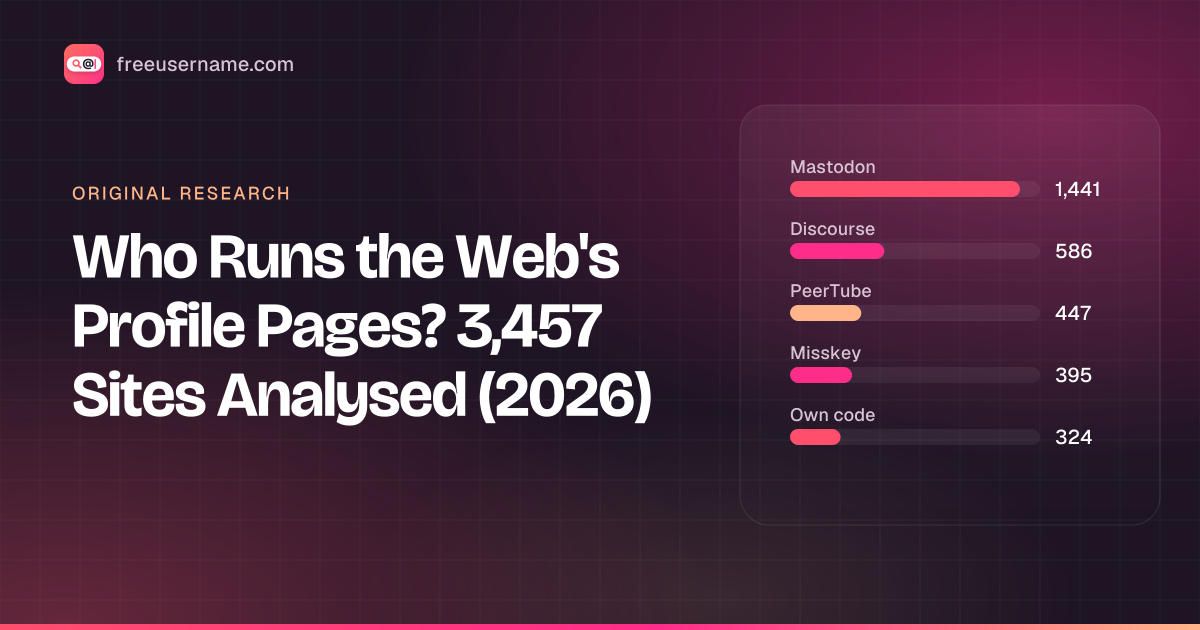
Who Runs the Web's Profile Pages? 3,457 Sites Analysed (2026)
Original data: 90.6% of the 3,457 sites in our username search run on 11 shared open-source platforms, and 71% are fediverse servers. What that means for your results.
· 6 min read
More from the blog
- What's Inside a 3,000-Site Username Checker? We Opened Ours
- We Ran Sherlock, Maigret, Blackbird and Our Engine on the Same 10 Usernames
- Reverse Gamertag Lookup: Find a Player Across Games
- How to Find Someone's Alt Twitter (X) Account
- Digital Footprint Check in Canada: Free, No Sign-Up
- PIPEDA Privacy Rights and Quebec Law 25, Explained