
What Is OSINT? Meaning, Definition and Examples
By David James · Published · Updated · 6 min read · Editorial policy
Free, no sign-up. Checks 3,450+ sites; the username is not stored or logged.
OSINT stands for open-source intelligence. In plain terms, the OSINT meaning is useful knowledge built from information anyone can lawfully get, such as websites, social media posts, news, public records, maps and satellite images. "Open source" here has nothing to do with open-source software. It means the source is open to the public, as opposed to secret sources like intercepted communications or informants.
The term comes from the intelligence world, but most people doing OSINT today are not spies. They are journalists checking whether a video is real, security teams looking at what their company exposes online, researchers tracking scams, and ordinary people checking what strangers can find about them.
How to define OSINT: the official definitions
If you need to define OSINT in one line, use the quick answer above. Longer definitions mostly trace back to two sources.
The US intelligence community defines it in its IC OSINT Strategy 2024-2026: "OSINT is intelligence derived exclusively from publicly or commercially available information that addresses specific intelligence priorities, requirements, or gaps." Note the last part. Intelligence answers a question someone actually needs answered.
The Berkeley Protocol on Digital Open Source Investigations, published by the UC Berkeley Human Rights Center and the UN Human Rights Office, draws a useful line. It defines open source information as "information that any member of the public can observe, purchase or request, without requiring special legal status or unauthorized access", and treats OSINT as the subset collected for decision-making, "most often in a military or political context". Human rights investigators and many journalists prefer to call their own work open source research or investigation for that reason. Bellingcat's getting-started guide notes that some people avoid the term OSINT because of its "direct connotations to intelligence agencies".
In everyday use, people say OSINT for all of it: finding, checking and making sense of public information.
Information is not intelligence
A pile of search results is not OSINT. The "intelligence" part is the analysis: deciding what question you're answering, collecting only what is relevant, checking it against other sources, and writing down what you found and how confident you are. A username that appears on twelve sites is information. Showing, with evidence, that four of those accounts belong to the same person and the other eight don't is intelligence.
Who uses OSINT
- Journalists and fact-checkers verify photos, videos and accounts, and trace where a claim started. Our guide for journalists covers source verification.
- Security teams map what an attacker could learn about their organization: exposed staff details, leaked credentials, forgotten servers, lookalike domains.
- Human rights investigators document events using public videos, images and satellite data.
- Fraud and trust-and-safety teams link scam accounts and fake profiles.
- Law enforcement uses public information within its legal powers.
- Brands watch for impersonation and handle squatting.
- Individuals check their own digital footprint, or whether a dating match or seller is who they claim to be.
Common OSINT sources
| Source | Examples | Typical question |
|---|---|---|
| Search engines | Exact-phrase and site: searches | Where is this name, handle or phrase mentioned? |
| Social media and forums | Public profiles, posts, comments | What does this account say about itself, and since when? |
| Usernames | The same handle across many sites | Which other accounts might belong to the same person? |
| Images and video | Reverse image search, metadata, landmarks | Where and when was this taken? Is it reused? |
| Web archives | The Wayback Machine | What did this page say before it changed? |
| Domain and network records | WHOIS/RDAP, DNS, certificate logs | Who registered this site and what else do they run? |
| Public records | Company registries, court filings, property records | Who owns or runs this business? |
| Maps and satellite imagery | Street-level and satellite views | Does this location match the photo? |
How an OSINT investigation works
- Define the question. "Is this account really the charity it claims to be?" is answerable. "Find everything about this person" is not, and it's where ethics problems start.
- Collect from sources that fit the question, and record each URL with the date you saw it.
- Preserve what you rely on with screenshots or archived copies, because pages change and disappear.
- Verify. Cross-check every important finding against an independent source. Matching usernames, similar photos and shared names are leads, not proof.
- Analyze and report what you found, how you found it, and how confident you are.
A small example: one username
Say a seller on a marketplace calls themselves "bluebirdcrafts" and you want to know whether they're established. A username search shows the handle on a craft site, a photo-sharing site and a forum. You open each: the craft-site shop has five years of reviews and the same product photos; the forum account is unrelated, a different person who picked the same name. Conclusion: the shop looks long-running, and you have links and dates to back that up. Our OSINT username search page walks through this method in more detail, and username OSINT for beginners is the next step if you want to practice.
OSINT tools
Most OSINT starts with a search engine and a notebook. Specialist tools speed up particular steps: username checkers such as Sherlock, Maigret and the WhatsMyName dataset; reverse image search; archive services; and frameworks such as SpiderFoot that combine many sources. Our OSINT tools hub has an independent write-up of each, and best free OSINT username tools compares the username ones.
Is OSINT legal?
Collecting information that is genuinely public is generally lawful, but OSINT has clear limits, and the method matters as much as the source:
- Public means public. Logging into accounts that aren't yours, guessing passwords, using leaked credentials or getting around privacy settings is not OSINT, and can be a crime.
- Privacy and data protection laws still apply. In the EU and UK, for example, collecting and storing data about identifiable people needs a lawful basis even if the data is public.
- Terms of service may ban automated collection on some sites.
- No harassment, doxing or stalking. Assembling and publishing someone's home address, workplace and daily routine can cause real harm and is illegal in many places.
- No FCRA uses in the US. Information gathered this way must not be used to decide on someone's employment, housing, credit or insurance outside a regulated background check.
If you'd be uncomfortable explaining your question and your method to the person you're researching, stop.
Start with yourself
The best way to learn OSINT, and the most useful, is to investigate your own footprint. Search your name in quotes, check where your usernames appear, and reverse-image-search your profile photo. FreeUsername checks a username against 3,450+ sites for free; try one of yours. The username is used only to run the check and is not stored or logged. Then work through the digital footprint check to clean up what you find.
FAQ
What does OSINT stand for?
Open-source intelligence. "Open source" means publicly available, not open-source software.
Is OSINT slang?
Not originally. OSINT is an acronym for open-source intelligence, a term from intelligence work. Online, people also use it casually for digging up public information, as in "someone OSINT'd the photo and found the location". Either way, it refers to public sources.
What is an example of OSINT?
Checking whether a viral photo is old by finding earlier copies with a reverse image search, or confirming that a company's social account matches its official website and registry filing.
Is username search OSINT?
Yes. Checking where a handle appears is one of the most common OSINT starting points, because people reuse usernames across sites. It only gives leads; each account still has to be verified. What is username enumeration? explains the security side of the same idea.
Is OSINT free?
Much of it is. Search engines, web archives, public registries and most username checkers cost nothing, and many well-known tools are free and open source. Some data sources and commercial platforms charge, especially for bulk or historical data. Our OSINT tools hub notes which tools are free.
Do I need special tools to do OSINT?
No. A search engine and careful notes cover most beginner work. Tools help when you need to check many sites or sources at once.
Related tools
Check a username now. Free, no sign-up, 3,450+ sites.

Search usernames on your phone. Get the free Android app. Scans run on your device.

Related in OSINT
- OSINT
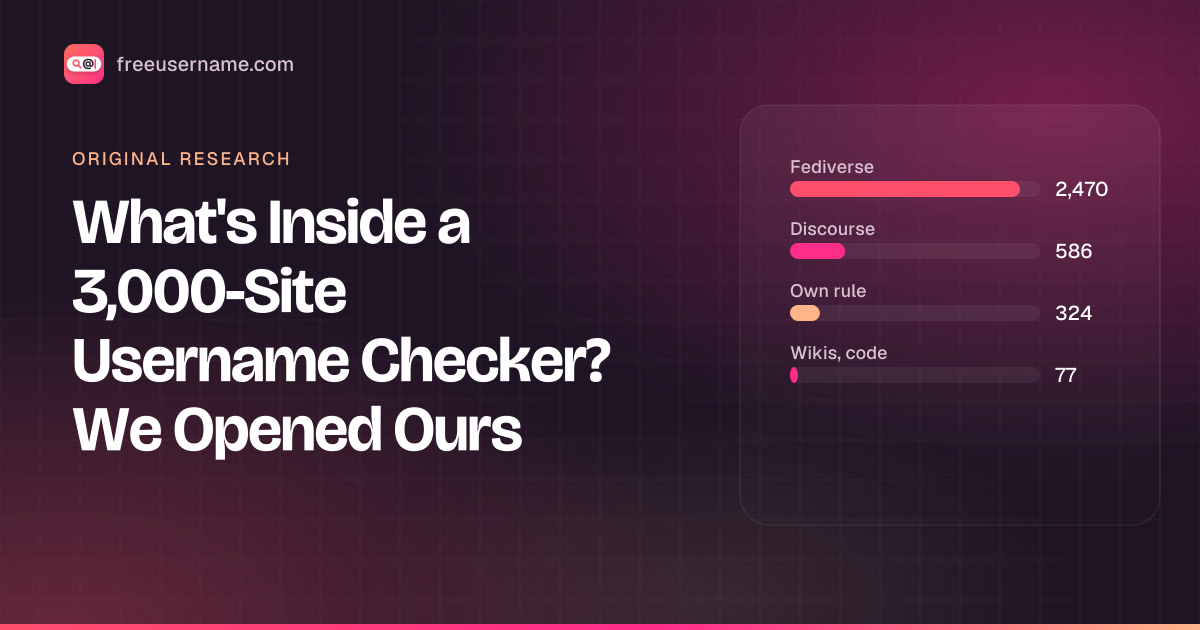
What's Inside a 3,000-Site Username Checker? We Opened Ours
Our username search checks 3,457 sites. 58 are major platforms; 91% run on about ten kinds of community software. The full breakdown, and what the number really means.
· 4 min read
- OSINT
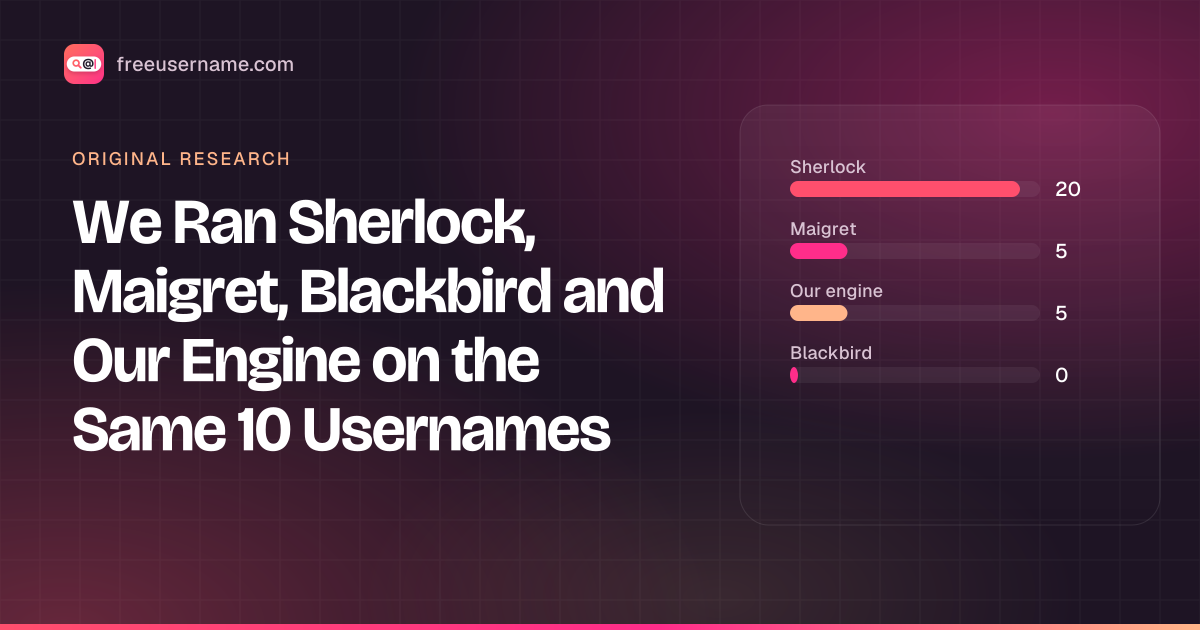
We Ran Sherlock, Maigret, Blackbird and Our Engine on the Same 10 Usernames
A reproducible test: 4 username tools, 10 handles, default settings. Hits, false positives on made-up names, errors and speed, with the raw CSV.
· 8 min read
- OSINT
Reverse Gamertag Lookup: Find a Player Across Games
Free gamertag lookup online: check one name on Xbox, PlayStation, Steam, Riot and more, do an Xbox gamertag search, then deep-search every site.
· 4 min read

More from the blog
- Cute Username Ideas: 65+ Soft, Aesthetic & Short Names
- WhatsMyName Apps Is Now FreeUsername: Our Rebrand
- Who Runs the Web's Profile Pages? 3,457 Sites Analysed (2026)
- The Username Format That Works on the Most Sites: We Tested 21 Formats Against 3,457 Sites’ Rules
- How to Find Someone's Alt Twitter (X) Account
- Username Availability Search: Is It Taken Everywhere?