
Dating App Safety: How to Check a Match Is Real
By David James · Published · Updated · 7 min read · Editorial policy
Free, no sign-up. Checks 3,450+ sites; the username is not stored or logged.
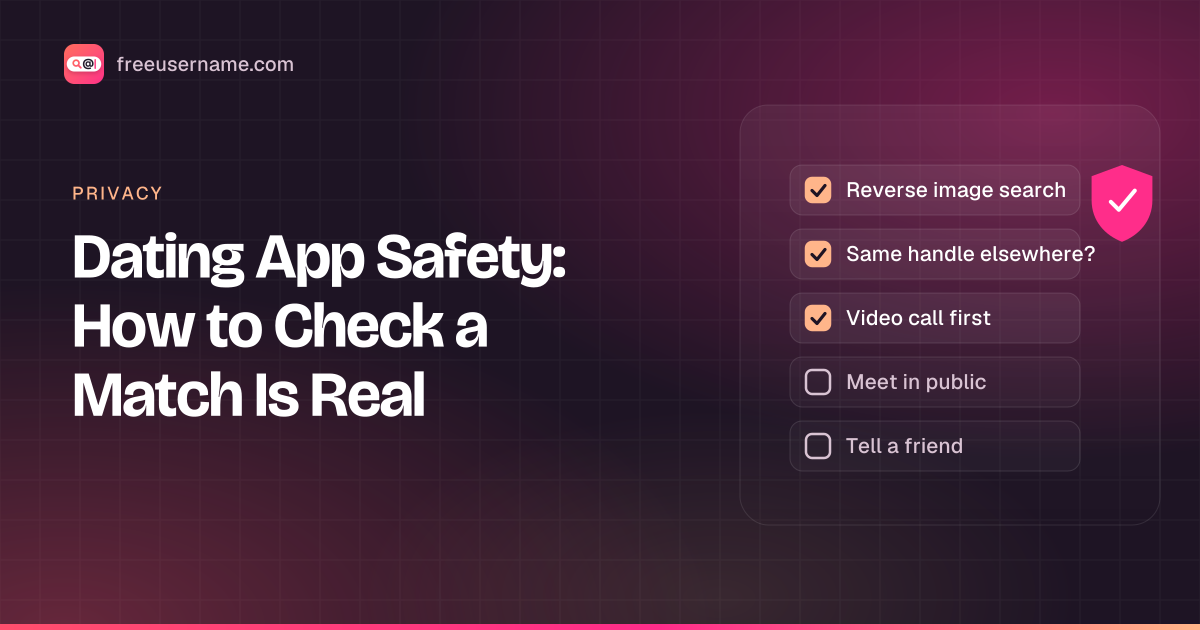
Most people you meet on dating apps are who they say they are. A few aren't. Some are romance scammers working from a script. Some are catfish using someone else's photos. A small number are dangerous. A few minutes of checking before you meet, or before the conversation turns to money, can tell you which kind of match you have.
This guide is about confirming that a match is a real person. It is not about digging into their life. Everything here uses information your match chose to share or made public, and the goal is a yes or no answer to one question: does this person exist roughly as described?
Ground rules: check, don't stalk
There is a clear line between a safety check and surveillance. Stay on the right side of it:
- Use only public profiles and information your match gave you.
- Don't try to find their home address, workplace schedule, family members or ex-partners.
- Don't create fake accounts to view private profiles or contact their friends.
- Don't bring up what you found in a way that feels like an interrogation. If something worries you, ask a direct question or step away.
- Stop once you have your answer.
Assume they may run the same checks on you. That's fair, and it is one more reason to keep your own public profiles tidy.
Consistent is not the same as safe. A match whose photos, usernames and video call all line up is probably who they say they are, but that tells you nothing about how they will treat you. Scammers also build accounts that look consistent. Never send money, gift cards or ID documents to someone you have only met online, whatever the checks show. In the US, report romance scams at reportfraud.ftc.gov; elsewhere, use your national fraud reporting service.
Step 1: Check the photos
Stolen photos are the most common sign of a fake profile. Run a reverse image search on one or two of their pictures using a search engine's image search. The FTC's guidance on what to know about romance scams suggests this too: if the picture shows up under a different name or with details that don't match, that's a sign of a scam.
Warning signs include photos that only ever look professionally shot, a model's portfolio or stock photo site in the results, or the same face appearing on several profiles with different names.
Step 2: Check any username they shared
People often share a handle when they move the conversation off the dating app, such as an Instagram, Snapchat or gaming name. A real person usually has a handful of accounts with some history behind them. A scammer often has one account created last month.
Put the handle into our username search. It checks 3,450+ sites, and for Found results it shows the public display name, avatar and bio when the site makes them available. You are looking for consistency:
- Do the photos and first name roughly match what you were told?
- Do the profiles have some age, with posts going back more than a few weeks?
- Does the location or job they mentioned line up with what is public?
Keep in mind that a Found result means a profile with that name exists. It doesn't mean your match owns it. Common handles are shared by many people, so only count a profile as theirs if the photos or details clearly match. Results marked Blocked or Unknown mean the check couldn't complete, not that something is wrong. And plenty of genuine people have almost no online presence, especially those who keep their profiles private for safety reasons. Little or nothing found is not a red flag on its own.
If you want to check one platform only, the platform checkers, such as the Instagram username checker, run a single site.
Step 3: Ask for a video call
This is the simplest test, and it beats anything an online search can tell you. A real match will usually agree to a short video call before meeting. A catfish or scammer will keep finding reasons not to: a broken camera, a bad connection, a job on an oil rig or overseas posting. Repeated excuses are an answer in themselves.
Tinder profile search and checking dating apps for free
People often search for a "Tinder profile search" or a way to check if someone is on dating apps free. Two facts help here. First, Tinder profiles are not public web pages, and there is no official way to search Tinder by name or username from outside the app. Sites that promise to search Tinder, Hinge or Bumble for any person are usually paid people-search services or outright scams, and they cannot see inside those apps either. Second, the apps themselves now do some of the verifying for you. Tinder's Photo Verified badge, awarded through its Face Check video selfie, which Match Group made mandatory for new users in several markets in 2025, shows the person in the photos took a live selfie that matched them. A missing badge is not proof of a fake, but a badge is a good sign.
The free checks that work are the ones in this guide: a reverse image search on their photos, a username search on any handle they shared, and a video call. They answer "is this match real?", which is the question that matters for safety.
They are not a way to track a partner. If you are worried that someone you are already with is active on dating apps, searching for them in secret rarely settles it and can damage trust or break the law where you live. Talk to them directly, or to someone you trust.
Can you search people on Tinder?
No. Tinder has no search box for people, by name or by username. The only way to find out if someone is on Tinder is the ordinary way: their profile shows up while you swipe, or they tell you. Sites that promise to search Tinder for a specific person usually want payment or personal details up front, and Tinder does not offer that data to them. Our tool cannot check Tinder either. It checks whether a username exists on public sites, which is useful only if your match shared a handle from another app.
Romance scam red flags
The FTC describes romance scammers as people who "create fake profiles on dating sites and apps" or reach out through social media. Their stories tend to follow a pattern. Watch for:
- Moving very fast: declarations of love within days, talk of a future together before you've met.
- Pushing you to leave the dating app for a private messaging app straight away.
- A life that keeps them far away: military deployment, offshore work, international business.
- Any request for money, gift cards, cryptocurrency, or help moving funds, however it is framed.
- Investment tips or "opportunities" they want to share with you.
- Requests to keep the relationship secret from friends and family.
The FTC's advice is blunt: "Never send money or gifts to a sweetheart you haven't met in person." If you suspect a scam, stop talking to the person, talk to someone you trust, and report the profile to the dating app. In the US, you can also report it to the FTC.
Safety tips for the first date
- Meet in a busy public place and get there and home on your own.
- Tell a friend where you are going, who you are meeting, and when you expect to check in. Share the match's profile and any username with them.
- Keep your phone charged and your drink with you.
- Don't share your home address, workplace details or financial information early on.
- Trust your gut. Leaving a date that feels wrong is always allowed.
Check your own profile too
The same searches that help you verify a match can be used by someone with bad intentions to learn more about you than you meant to share. Before you start dating, run your own handles through our digital footprint checker. Look for old accounts that show your full name, your workplace or your neighborhood, and lock down or delete what you don't want strangers to see. Using a dating-only username that you don't use anywhere else is a simple way to keep the two parts of your life apart.
Our tool is free and needs no sign-up. The username is sent to our server only to run the check, and we don't store or log it. You can check up to five handles at once. We do not offer email or phone lookups. Those checks are marked as coming soon and are not live.
More on how these tools work
If you want to understand the technique behind a username search, our OSINT username search page explains it, and the OSINT tools hub covers other free tools. The online dating safety page has a shorter version of this checklist, and the use cases section covers other personal and professional uses.
A quick check is a reasonable precaution, the same as meeting in public. Do it, get your answer, and then get on with the date. Start by checking a username.
FreeUsername is not a consumer reporting agency, and its results must not be used for decisions about employment, credit, housing or insurance.
Related tools
Check a username now. Free, no sign-up, 3,450+ sites.

Search usernames on your phone. Get the free Android app. Scans run on your device.

Related in Privacy
- Privacy
Digital Footprint Check in Canada: Free, No Sign-Up
A free digital footprint check for Canada: search your usernames, Google yourself and clear out people search listings. No sign-up, about 15 minutes.
· 5 min read
- Privacy
PIPEDA Privacy Rights and Quebec Law 25, Explained
Your PIPEDA privacy rights in plain words: how to request your personal information in Canada, how to complain to the OPC, and what Quebec Law 25 adds.
· 5 min read
- Privacy
Remove Yourself from People Search Sites in Canada
People search sites in Canada can list your name, phone, address. How to find your listings, use opt-outs, cite PIPEDA and escalate to the OPC if needed.
· 5 min read
More from the blog
- Cute Username Ideas: 65+ Soft, Aesthetic & Short Names
- WhatsMyName Apps Is Now FreeUsername: Our Rebrand
- What's Inside a 3,000-Site Username Checker? We Opened Ours
- Who Runs the Web's Profile Pages? 3,457 Sites Analysed (2026)
- We Ran Sherlock, Maigret, Blackbird and Our Engine on the Same 10 Usernames
- The Username Format That Works on the Most Sites: We Tested 21 Formats Against 3,457 Sites’ Rules