
The Ethics of Searching for Someone's Social Profiles
By David James · Published · Updated · 7 min read · Editorial policy
Looking someone up online is so easy that it rarely feels like a decision. You type a name or a handle, open a few profiles and close the tab. Most of the time nothing comes of it. But the same few clicks are also how stalkers find a new address, how harassers find a target's family, and how a bad hiring decision gets made on a namesake's old posts.
Key takeaways
- Viewing what someone made public is legal in most places. Harassing, doxxing, getting past privacy controls or using results for hiring or housing decisions is where the law steps in.
- Public does not mean permission. Combining scattered posts into one picture is where most harm comes from.
- Have a clear reason, collect the least you need, and treat a username match as a lead, not proof.
- Never search for someone on another person's behalf, especially an ex who has moved away.
Searching for someone's social profiles means looking up the public accounts tied to their name or handle. When it is done for research or investigation, it is often called OSINT (open-source intelligence).
This post is about the ethics of searching for someone's social profiles: when it is fine, when it is not, and how to tell the difference before you start. It also covers the legal side in general terms. It is not legal advice, and laws differ a lot between countries and states.
Is it legal to look someone up?
In most places, viewing information that someone made public is legal. Searching a name, opening a public profile or reading a public post is not a crime in itself. The legal trouble starts with what you do next, and with how you got the information.
| What you do | Usually legal? | Laws that can apply |
|---|---|---|
| Open a public profile or post | Yes, in most places | None in itself |
| Harass, threaten or follow someone | No | Stalking and harassment laws |
| Publish private details to expose someone (doxxing) | Often not | Doxxing or harassment laws |
| Log in to their account or use a fake account to see private posts | No | Computer misuse laws, platform terms |
| Use results to decide on jobs, housing, credit or insurance | Only under strict rules | Consumer reporting laws such as the FCRA |
In more detail:
- Using it to harass, threaten or follow someone can break stalking and harassment laws. Every US state has a stalking law, and the federal stalking statute covers a course of conduct carried out online or through electronic communication services, with intent to harass or intimidate, that puts someone in reasonable fear of serious harm or causes substantial emotional distress. The UK's Protection from Harassment Act and similar laws elsewhere work in a similar way.
- Publishing someone's private details to expose or intimidate them, often called doxxing, is a specific offense in some jurisdictions and can fall under harassment laws in others.
- Getting past privacy controls by logging into someone's account, guessing a password or using a stolen session can break computer misuse laws. Fake accounts used to get into private profiles break most platforms' terms and can support a harassment claim.
- Using results for decisions about jobs, housing, credit or insurance brings in consumer reporting laws such as the US Fair Credit Reporting Act, which the FTC enforces. A free search tool is not a background check.
Data protection law matters too. In the EU and UK, GDPR mostly applies to organizations; purely personal or household activity is exempt. A business or researcher collecting profiles on people needs a lawful basis and has to handle that data properly.
Public is not the same as permission
Public information is not consent to collect and combine it. The most common argument for any search is "it's public." That is true and also incomplete. A person who posts a gym selfie, a running route, a workplace badge and a dog's name on four different sites made each item public for a particular audience. Pulling them together into one picture creates something none of those posts were meant to be. Researchers call this aggregation, and it is where most of the harm in OSINT comes from.
So the useful question is not "can I see it?" but "should I combine it, and for what?"
Five questions to ask before you search someone
Ask these five questions first, and stop if any answer makes you uneasy.
- Why am I doing this? Checking that a dating match is real, verifying a seller, looking into an account impersonating you, or authorized work are clear reasons. Curiosity about an ex, a grudge, or "just to see" are not.
- Would they expect it? A business contact expects you to glance at their professional profile. A person who blocked you expects you to stay away.
- What is the least I need? If the question is "is this person real?", one matching photo and a video call answer it. You do not need their family tree.
- What happens if I am wrong? Names and handles are shared. Acting on a mistaken match can hurt an innocent person.
- Would I be comfortable if they saw my search? If the honest answer is no, stop.
Here is how that plays out. Say a dating match calls themselves nightowl92 and you want to know they are real before meeting. Your reason is safety, and they would expect a quick check. The least you need is one profile that matches their photos and story, so you search that one handle and stop there. If nightowl92 turns up on a gaming site with a different face, you do not dig further. You ask them on a video call. You do not hunt for their workplace, family or home address. That would go far past the question you started with.
OSINT ethics for professionals
Professionals follow a short set of rules: collect only what you need, avoid harm, record your method and check before acting. Journalists, security teams and researchers do this work every day, and their standards are a good model for anyone. Guidance such as the Berkeley Protocol on Digital Open Source Investigations, published with the UN human rights office, and the codes used by newsrooms share a few principles:
- Necessity and proportionality. Collect what the task needs and no more.
- Minimize harm. Think about bystanders: friends in photos, family members, people with the same name.
- Document methods. Record where each finding came from and when, so others can check your work.
- Verify before acting. Treat a matching username as a lead, not proof. Confirm with independent signals.
- Secure what you collect, and delete it when the job is done.
Our guides on username OSINT for journalists and username OSINT for beginners put these into practice.
Consent and searching on someone's behalf
The cleanest searches are ones where the person agreed. Helping a parent clean up their accounts, auditing a client's brand handles, or checking a friend's footprint at their request are all fine. Ask first, show them what you found, and let them decide what happens next.
Searching for someone on behalf of a third party is different. If a person asks you to find out where an ex now lives or works, the answer is no, however the request is framed. People who are leaving abusive relationships often depend on not being found.
Partners, exes and children
Partners, exes and children are where searches most often cross a line. Three situations come up again and again:
- Partners. Checking a new match is real before meeting is reasonable. Monitoring a current partner's accounts, follows or messages is control, and in some places it is illegal. Our dating app safety guide keeps to the first.
- Exes. If contact has ended, searching for them serves no safety purpose. If you are the one being searched, block, document and report.
- Children. Parents have a real role in their children's safety, and an open conversation about which apps they use does more than covert searches. Our family privacy page covers this.
How we handle this at FreeUsername
We limit the tool to usernames and publish rules for using it. Our tool checks one thing: whether a public profile with a given username exists on 3,450+ sites. It does not search by real name, phone number, email or address, does not show private content, and does not store or log the usernames people search. We publish a responsible-use policy: your own accounts, your brand's, or research you are authorized to do; no harassment, doxxing or stalking; and no use of results for decisions about employment, credit, housing or insurance.
The best use of a username search is the one aimed at yourself. Check your own handle to see what a stranger could connect to it, then tidy up what you find with our digital footprint guide.
FAQ
Is it stalking to look at someone's social media?
Viewing a public profile once is not stalking in the legal sense. Stalking laws generally look at a pattern of conduct that causes fear or distress, such as repeated monitoring, contact after being told to stop, or showing up in person. If someone has asked you to leave them alone, searching for them is a step in the wrong direction.
Can I get in trouble for searching someone's username?
Checking a public username is generally legal. What you do with the results, and whether you bypassed privacy controls, is what matters. Laws vary, so seek local legal advice for a specific situation.
Do people know when I look them up?
Search engines and username checks do not notify anyone. Some networks show profile viewers on certain account types, so assume a visit may be seen.
This post is general information, not legal advice. FreeUsername is not a consumer reporting agency, and its results must not be used for decisions about employment, credit, housing or insurance.
Related tools
Check a username now. Free, no sign-up, 3,450+ sites.

Search usernames on your phone. Get the free Android app. Scans run on your device.

Related in OSINT
- OSINT
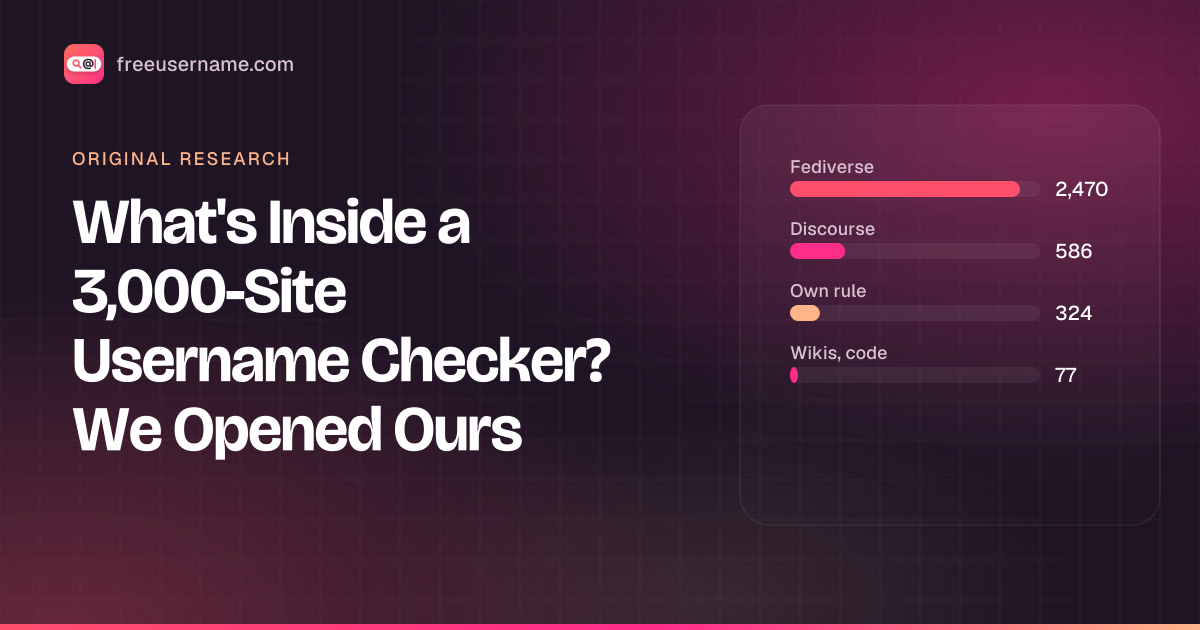
What's Inside a 3,000-Site Username Checker? We Opened Ours
Our username search checks 3,457 sites. 58 are major platforms; 91% run on about ten kinds of community software. The full breakdown, and what the number really means.
· 4 min read
- OSINT
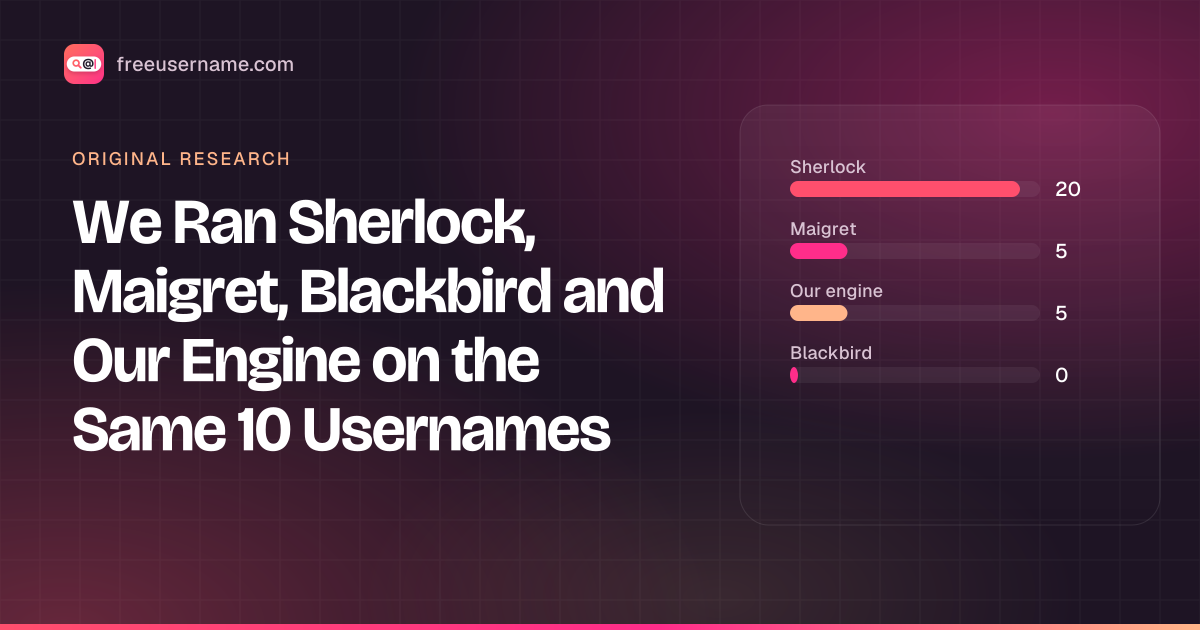
We Ran Sherlock, Maigret, Blackbird and Our Engine on the Same 10 Usernames
A reproducible test: 4 username tools, 10 handles, default settings. Hits, false positives on made-up names, errors and speed, with the raw CSV.
· 8 min read
- OSINT
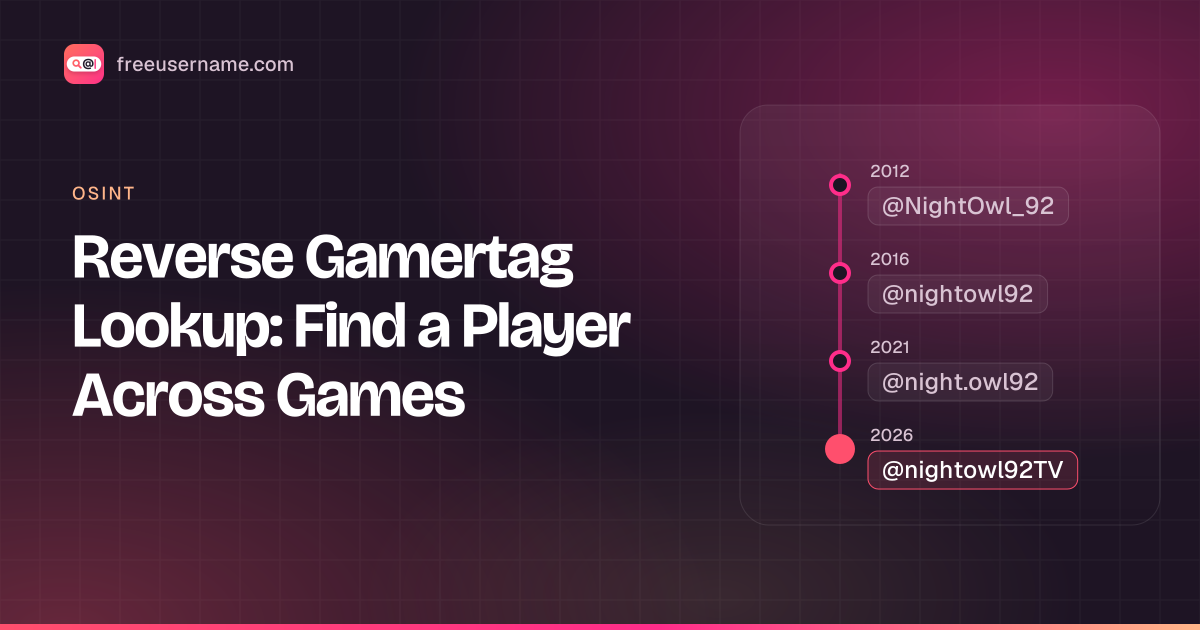
Reverse Gamertag Lookup: Find a Player Across Games
Free gamertag lookup online: check one name on Xbox, PlayStation, Steam, Riot and more, do an Xbox gamertag search, then deep-search every site.
· 4 min read
More from the blog
- Cute Username Ideas: 65+ Soft, Aesthetic & Short Names
- WhatsMyName Apps Is Now FreeUsername: Our Rebrand
- Who Runs the Web's Profile Pages? 3,457 Sites Analysed (2026)
- The Username Format That Works on the Most Sites: We Tested 21 Formats Against 3,457 Sites’ Rules
- How to Find Someone's Alt Twitter (X) Account
- Username Availability Search: Is It Taken Everywhere?